CoSPlan logo

CoSPlan: Corrective Sequential Planning via Scene Graph Incremental Updates

1University of California San Diego, 2University of Central Florida,

ECCV'26

Model Rankings on CoSPlan

Rank Model Robo-VQA-E Shuffle-E Maze-E Blocks-World-E Average Step Completion
1 GPT-4o 52.2 30.1 46.1 54.3 45.7
2 Intern-VLM 25.1 23.4 41.2 18.9 27.1
3 CoG-VLM 21.5 23.7 26.5 26.7 24.6
4 Janus-pro-7B 21.3 23.5 21.7 25.1 22.9
5 Qwen2-VL-8B 18.9 25.1 28.3 18.8 22.8
6 Random 20 20 20 20 20.0
Models ranked by average Step Completion accuracy across all CoSPlan tasks (using Scene Graph method)


Teaser Figure

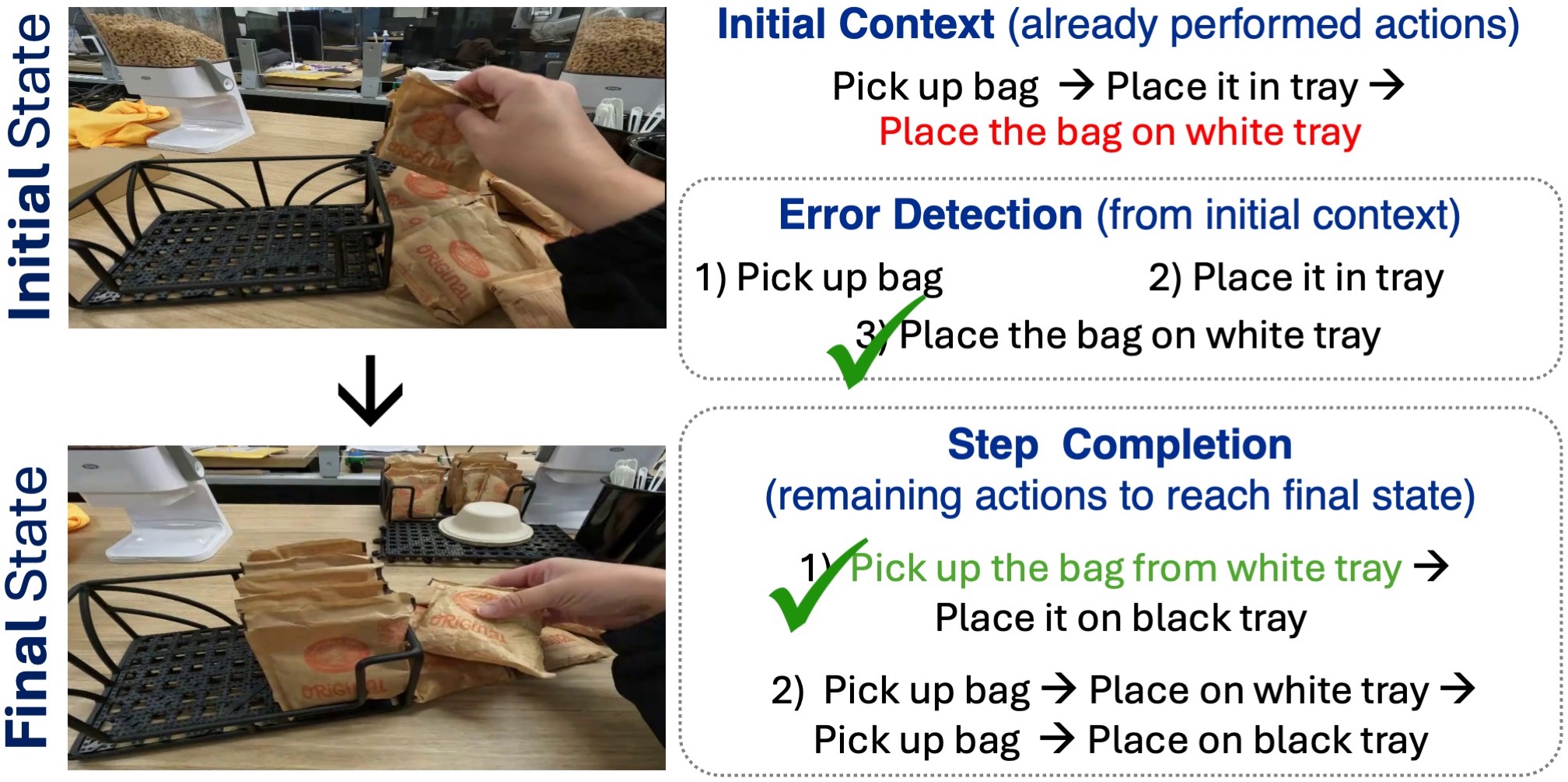
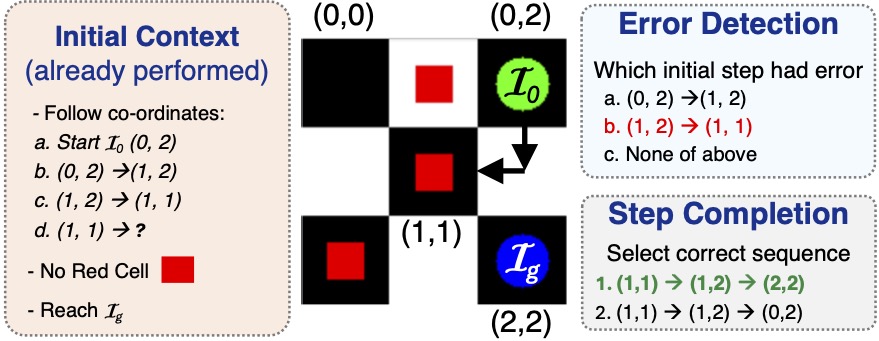
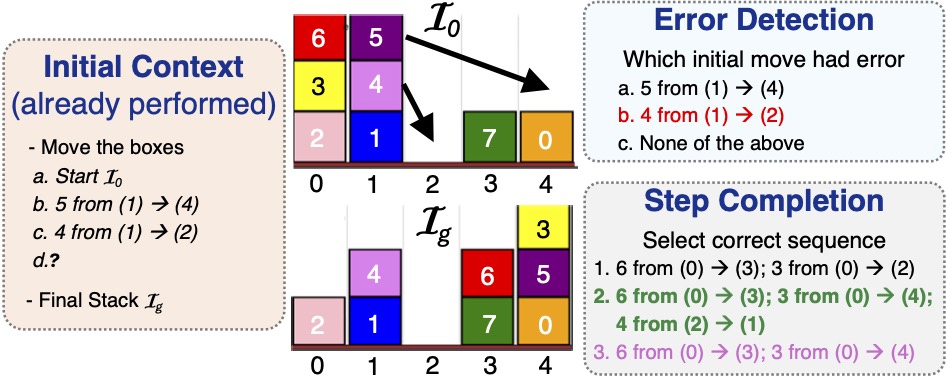
Corrective Sequential Planning: Given the initial and final states, with already performed actions with some errors (initial context), model identifies errors in the provided context, and picks the optimal action steps to reach the final goal, correcting the error.

Abstract

Vision Language Models (VLMs) have shown promising planning capabilities, yet their success remains confined to the text domain, leaving visual decision-making relatively underexplored. Addressing this gap, we introduce Corrective Sequence Planning (CoSPlan) benchmark, where VLMs must plan a sequence of visual actions from an initial scene to a target scene. CoSPlan evaluates models on their ability to imagine and execute a coherent set of visual steps required to reach the goal (Step Completion). To prevent any shortcuts that simply describe the final scene, we introduce an erroneous action in decision making, which must be detected (Error Detection) and corrected to reach the goal, enabling a deeper understanding of the task. CoSPlan spans across 4 tasks: maze navigation, block re-arrangement, image reconstruction, and object re-organization. Despite using advanced reasoning strategies such as Chain-of-Thought and Scene Graphs, VLMs struggle on CoSPlan, while still showing promising performance in the text domain. Addressing this, we propose Scene Graph Incremental updates (SGI), a novel training-free method to transform images into β€˜textual’ scene graphs, enabling step-by-step reasoning through iterative scene graph refinement. SGI yields an average of ~4.4% ↑ on CoSPlan w/ generalization on PlanBench and VQA. Link for solving puzzles above.

CoSPlan Benchmark

We introduce CoSPlan (Corrective Sequence Planning), a benchmark designed to study VLMs' planning capabilities in erroneous scenarios. CoSPlan focuses on 2D spatial vision tasks guided by text-based instructions, requiring models to plan a temporal sequence of actions toward a goal (temporal), while detecting and correcting an erroneous action.

CoSPlan includes four diverse tasks:

  • Maze-E: Navigation in a 2D maze with obstacles and erroneous moves.
  • Blocks-World-E: Re-arranging colored blocks into a target configuration.
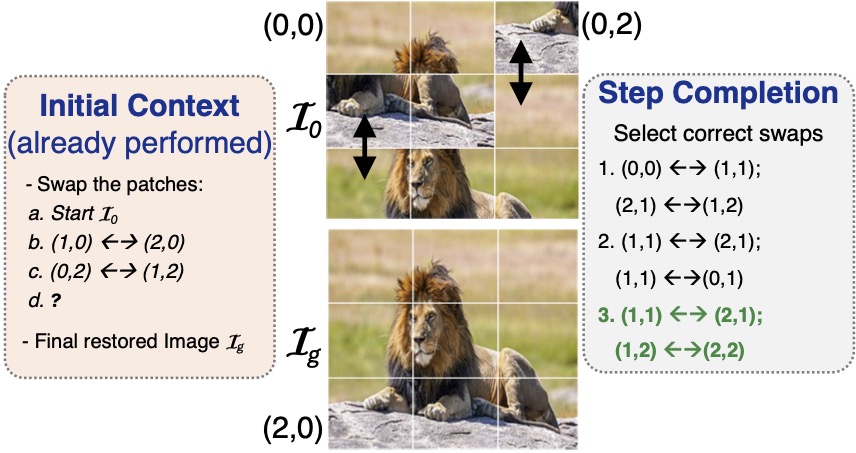
  • Shuffle-E: Reconstructing shuffled image tiles to form the original image.
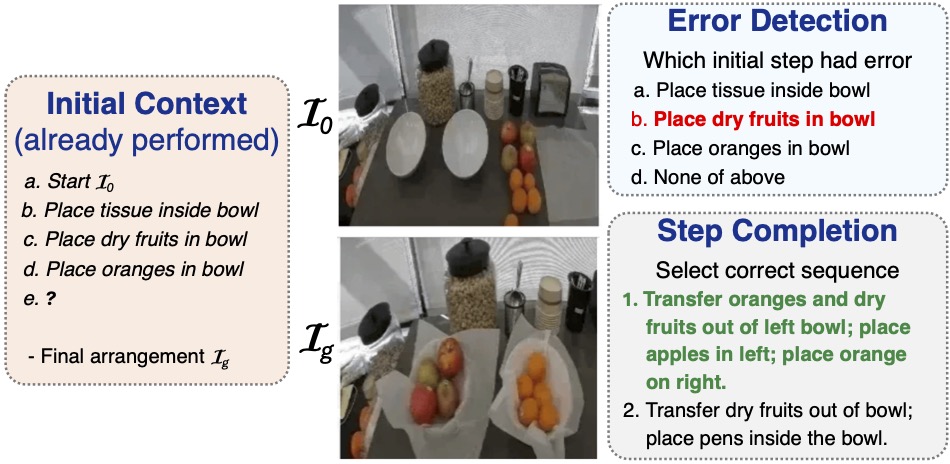
  • Robo-VQA-E: Re-organizing real-world objects based on instructions.

Model Task Type Size Initial Context
(# of already performed actions)
Remaining Steps
(#remaining steps to reach goal)
Source
Maze-E Navigation Path Planning 5000 2.0 4.6 Synthetic
Blocks-World-E Re-arrange Blocks 5000 2.0 3.8 Synthetic
Shuffle-E Re-construct Puzzle 1000 3.7 7.1 ImageNet
Robo-VQA-E Re-organize Real-world 350 5.5 4.1 ROM
Dataset Stats
Maze E Navigating
(a) Maze E (Navigating): Only navigating (β†’, ↑, ←, ↓) from green to blue cell, avoiding cells marked in red
Blocks World Rearrangement
(b) Blocks World (Rearrangement): X from (a) β†’ (b) rearranges block β€˜X’ from column β€˜a’ to column β€˜b’.
Shuffle E Reconstruction
(c) Shuffle E (Reconstruction): Re-constructing target image Ig by swapping (↔) image patches.
Robo VQA Reorganization
(d) Robo VQA (Reorganization): Re-organizing real-world objects

Overview of CoSPlan Benchmark Datasets: Maze-E, Blocks-World-E, Shuffle-E, and Robo-VQA-E.

Analysis


Why Model Give wrong Results (Generic)

MCQ Wrong answer
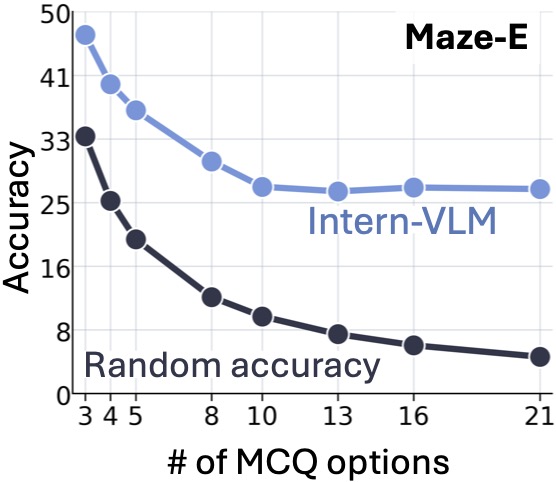
(a) As number of MCQ option goes up accuracy falls
MCQ Wrong answer
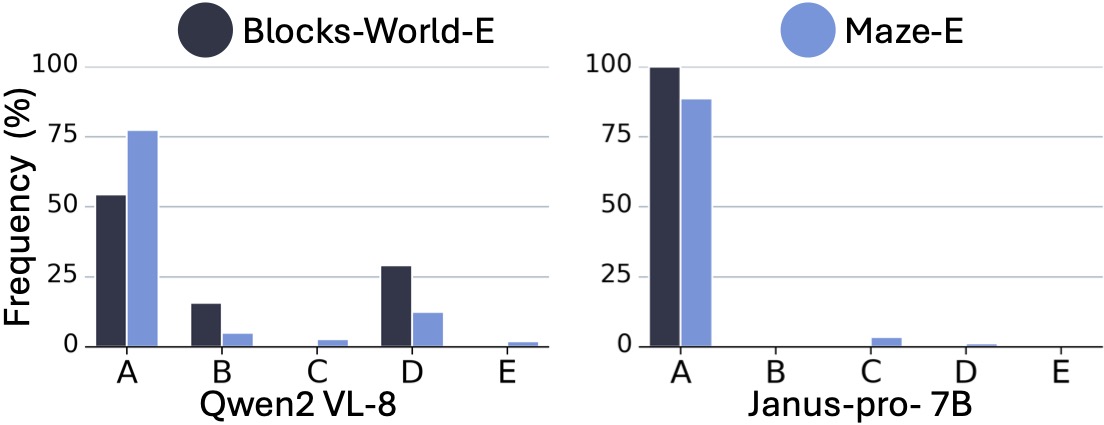
(b) Models have a strong bias towards picking option A
Shuffle E Reconstruction
(c) Models dont reason well with visual problems

Why Handling Error is difficult (Ours)

MCQ Wrong answer
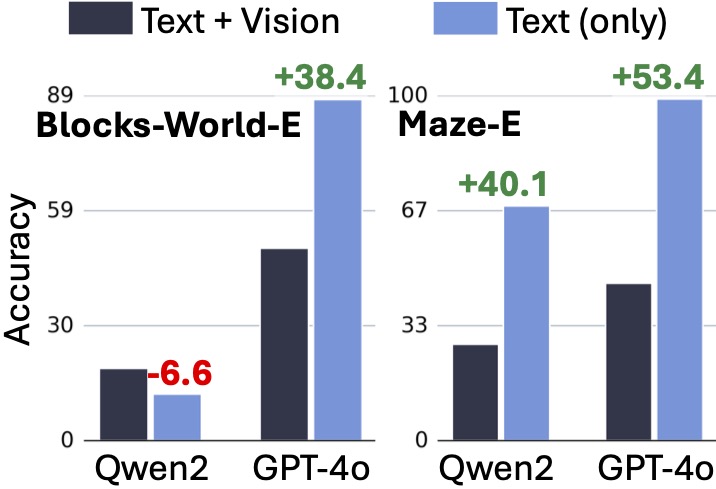
(a) Without Error models have a higher accuracy
MCQ Wrong answer
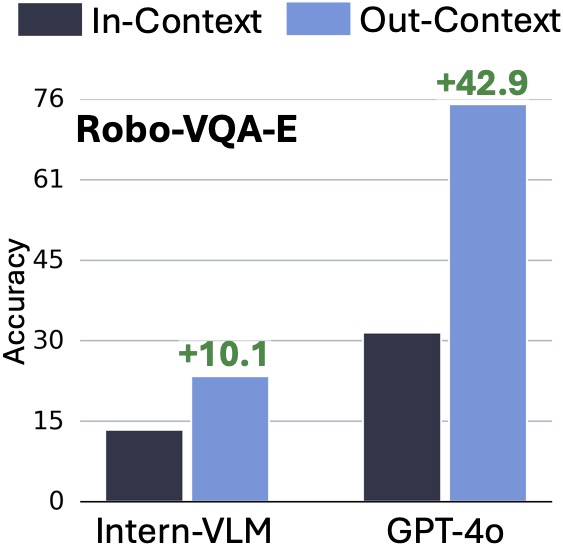
(b) Error related to objects in the scene (in-context) are harder to handle
Shuffle E Reconstruction
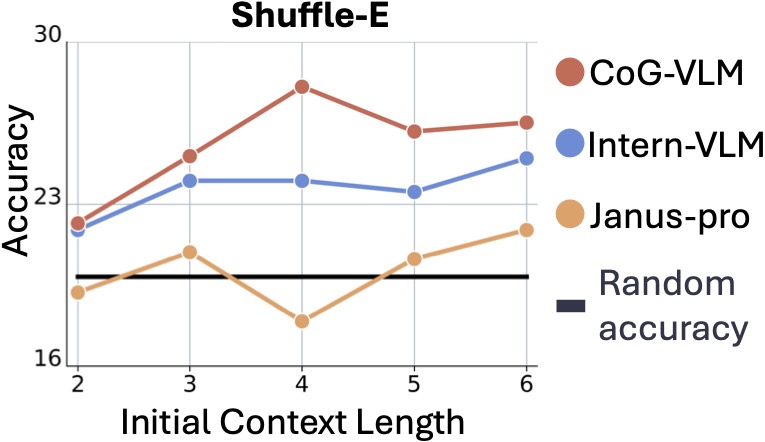
(c) The higher the intial context (already performed actions) better the accuracy
Shuffle E Reconstruction
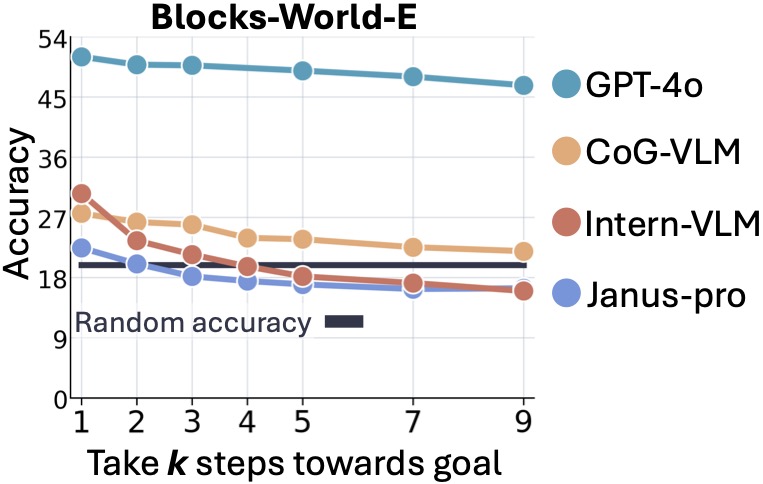
(d) Number of steps required to reach the goal. Models dont seem to take advantage of projected paths towards goal in picking up the option.

Solution : Scene Graph Incremental Update (SGI)

Motivation: With only initial and final images, models internally interpolate missing states (CoT & SG), a process they struggle in the visual domain, even though they perform with relative ease in the text domain

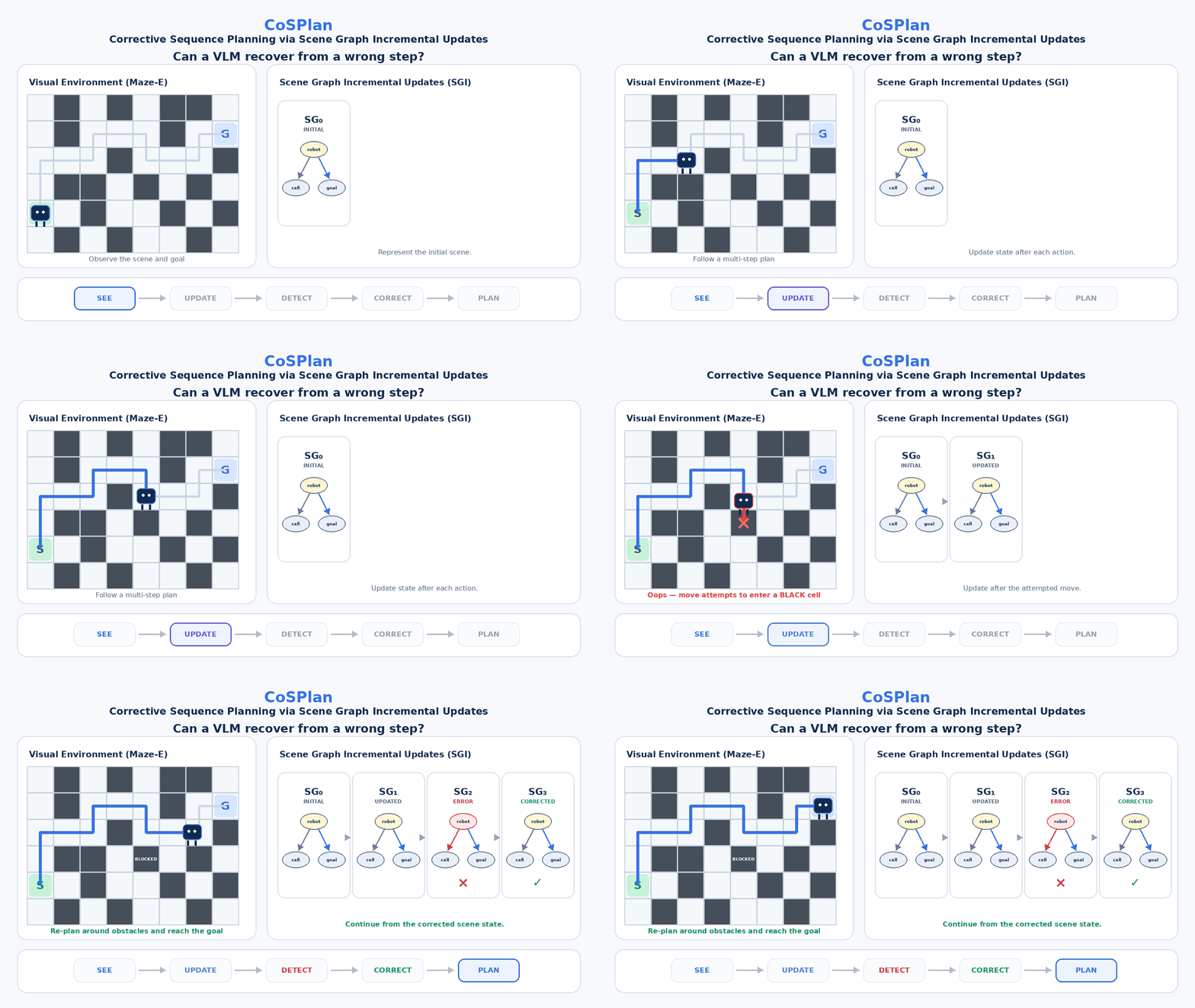
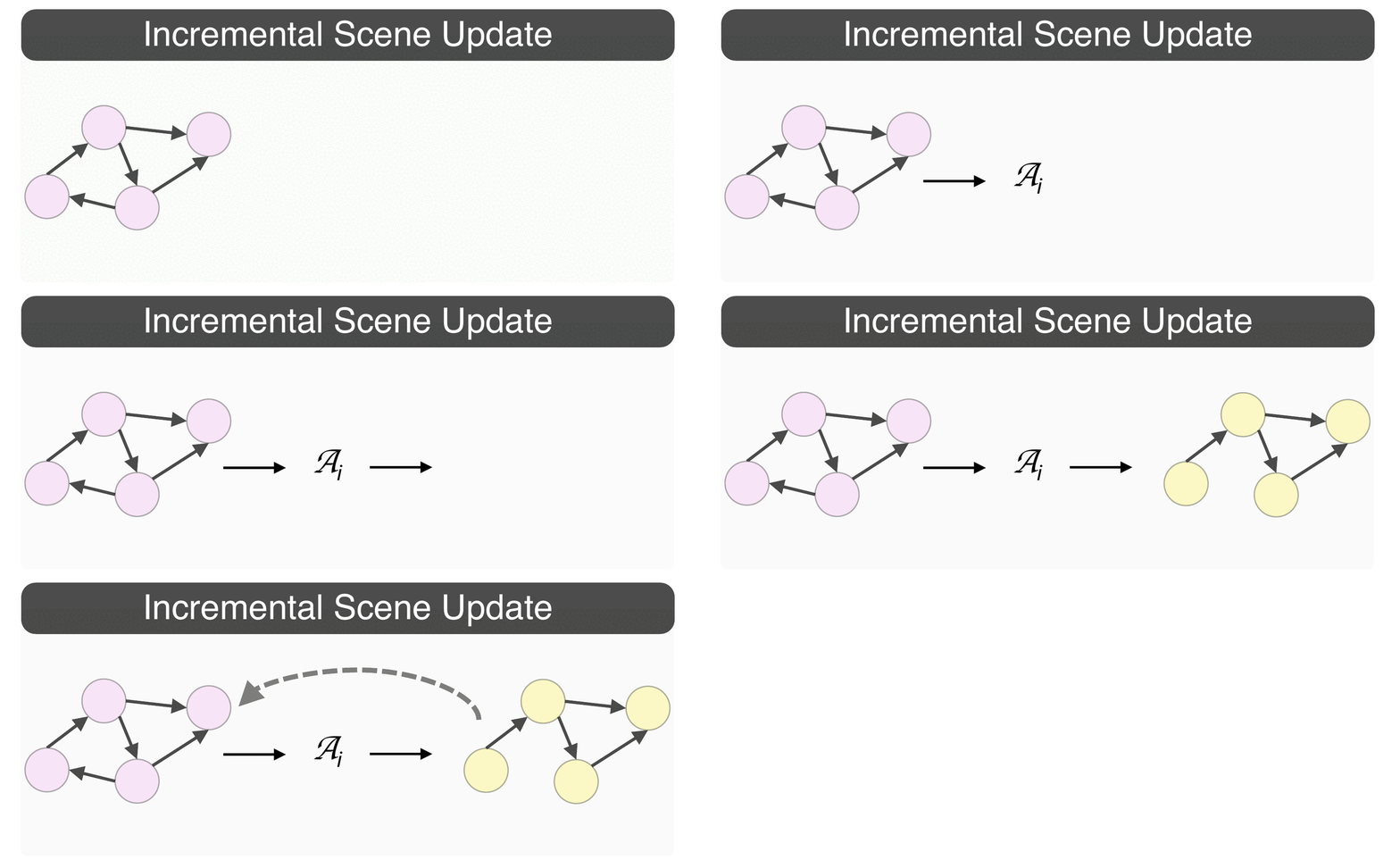
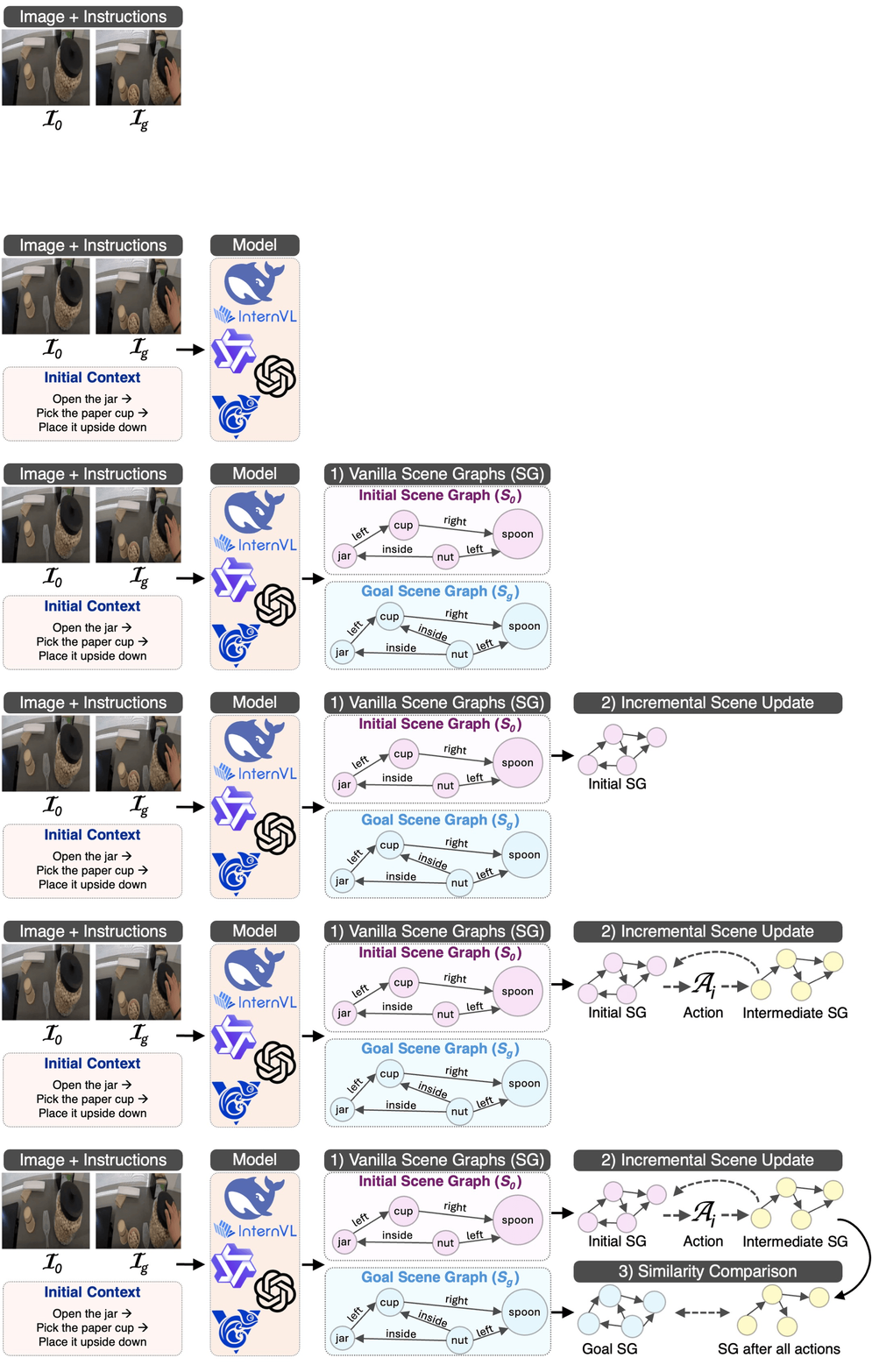
Solution: We leverage SG to transform visual images into textual representations, and apply an iterative step-by-step reasoning on text space instead of the visual domain. Instead of reasoning within a single static scene, SGI explicitly derives next-time-frame scene graphs as actions unfold in evolving scenes (See Gif below). This incremental formulation bridges the gap between the initial and final states via explicit intermediate states, and decomposing reasoning into smaller transitions, thereby improving corrective sequence planning and error detection.

SGI consists of three main steps:

  1. Vanilla Scene Graphs (SG): Generate initial and goal Scene Graphs.
  2. Incremental Scene Update: Simulate each action to update the Scene Graph incrementally, creating intermediate representations.
  3. Similarity Comparison: Compare the resulting Scene Graph with the goal Scene Graph to select the correct sequence of actions.

SGI Framework

SGI Method: 1) Initial and Goal Scene Graphs (SG) are generated. 2) Incremental Scene Update sequentially modifies SG for each action. 3) Similarity Comparison matches the resultant SG with Goal graph for searching for the best-aligned sequence.

Scene Graph Incremental Update (SGI) Results

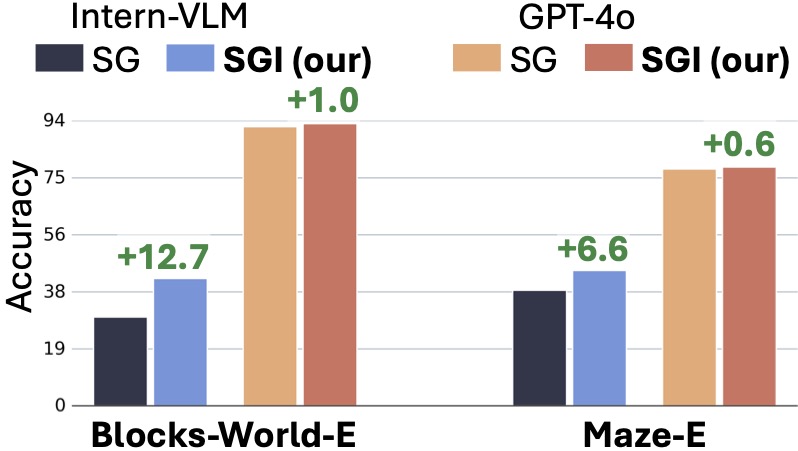
SGI improvement relative to vanilla Scene Graph (SG) method. All values show percentage accuracy (↑ higher is better).

Step Completion Performance

Method Robo-VQA-E Shuffle-E Maze-E Blocks-World-E
SG SGI SG SGI SG SGI SG SGI
Intern-VLM - 2 25.1 32.1 (+7.0) 23.4 25.2 (+1.8) 41.2 43.2 (+2.0) 18.9 29.2 (+10.3)
Intern-VLM - 3 31.4 33.7 (+2.3) 27.1 28.6 (+1.5) 50.1 54.8 (+4.7) 29.4 30.6 (+1.2)
GPT-4o 52.2 56.4 (+4.2) 30.1 37.0 (+6.9) 46.1 56.1 (+10.0) 54.3 55.3 (+1.0)

Error Detection Performance

Method Robo-VQA-E Maze-E Blocks-World-E
SG SGI SG SGI SG SGI
Intern-VLM - 2 26.1 31.5 (+5.4) 33.4 34.8 (+1.4) 37.3 42.9 (+5.6)
Intern-VLM - 3 28.1 29.5 (+1.4) 35.1 36.3 (+1.2) 44.3 45.1 (+0.8)
GPT-4o 44.2 57.4 (+13.2) 35.3 41.1 (+5.8) 42.1 50.7 (+8.6)

Additional SGI Results

MCQ Wrong answer

SGI improves performance on error-free scenarios


Method Spatial Map Maze Nav Spatial Grid
CoTSGSGI CoTSGSGI CoTSGSGI
CoG VLM 25.136.7 35.8 32.332.431.2 30.134.338.2
Janus pro 7B 42.447.447.8 20.827.329.3 34.435.836.3
Intern VLM 36.341.344.3 28.640.542.1 33.333.835.1
SGI on VQA dataset
SGI (Qwen2 VL 8B) on PlanBench (Task 8)
Method Score
Vanilla 13.8
CoT 14.1
SG 13.9
SGI (our) 14.7

BibTeX

@misc{grover2026cosplan,
      title={CoSPlan: Corrective Sequential Planning via Scene Graph Incremental Updates}, 
      author={Shresth Grover and Priyank Pathak and Akash Kumar and Yogesh S Rawat},
      year={2026},
      eprint={2512.10342},
      archivePrefix={arXiv},
      primaryClass={cs.CV},
      url={https://arxiv.org/abs/2512.10342}, 
      }